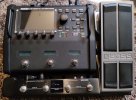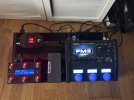
Let's see those FM3 rigs!

I'm loving this setup. I have a Temple Duo 17 that I'm trying to set up. I'm going to use a Hotone double switch, as well as a Midi Baby 3. I may have to mount the switches under the board like you did. I was wondering if you could share the tweaked version of the FM3 Alone layout that you're using?

Hi there. I love my little setup. It's perfect for me. I started off with FM3 Alone layout, which is great, and made a few tweaks here and there as I was going along. Off the top of my head I don't remember what I tweaked but it would be specific to me and my use case scenario. I can send the file to you when i get home from work.

Here is what the Hotone switches and Midi Baby do:

I use the 4 switches as stand-in switches. From left to right...

Switch 1 is tap to increment views and hold to decrement views.
Switch 2 is tap to show scenes and hold to show presets.
Switch 3 is tap to show effects and hold to show channels.
Switch 4 is tap to show control switches and hold to show looper.

Switch 5 is the Midi Baby. Tap tempo and hold for tuner

I really like this arrangement. Works great. For me. I don't gig anymore. If I was gigging with it, I might set it up differently. But for home use, creating, experimenting, recording, I like it. I pick a function with a switch... then I either select something on the FM3 or... page up or down with Switch 1 then select something on the FM3. It makes sense to me. I can get around on it pretty fast like this. Hope that makes sense.

Btw, I use this setup (Dunlop & Midi Baby) with NDSP plugins also. Midi Baby is set up for preset up down for the plugins.
 
Last edited:
Here again is my next final iteration!

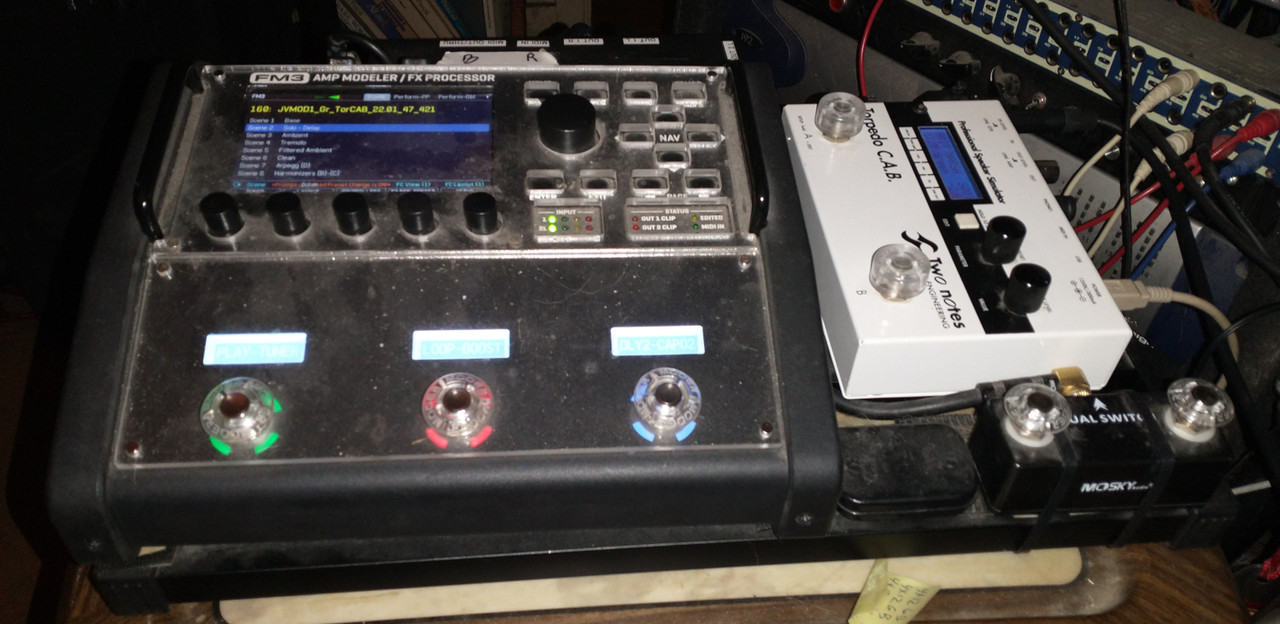
Gokko/Soyan 12" X 18" aluminum pedalboard.

Two Notes Torpedo CAB (provides cab and mic(s), room/reverb, and EQ, there by saving over 20% CPU). This gen one CAB from yester-year replaces a UA OX Stomp, which in many ways sounds better, but is much more limited in cab/mic selection and mic positioning granularity, plus the CAB's software editor is fully featured and professional, where as the OX Stomp's editor lacks a number of important features. The Torpedo CAB is powered via the FAS Link.

Mosky Dual Footswitch.

Ceba Screen Protectors.

Mooer Footswitch Toppers.

Mooer Footswitch Shrooms.

Mono Club 2.0 Case

Custom Patchbay (to save the FM3's connectors from people tripping on cables on blacked out stages).

The whole pedalboard complete with cheap case, DIY patchbay and cabling cost around $100, including clockable XLR's and right-angle MIDI connectors, D-Series punched project box, plus the D-Series 5-Pin DINs and XLR connectors, and the D-Series1/4" connector.

FC Setup...

FC1 tap controls the Ableton LIVE Looper Plugin's Play button, and hold the FM3's Tuner.
FC2 tap controls the Ableton LIVE Session Loop button, and hold the Ableton LIVE Looper Plugin's Undo button plus a Boost.
FC3 tap switches Delay FX, and hold selects the Virtual Capo.

The Mosky Dual Switch 1 tap increments Scenes, and hold decrements Scenes (the majority of FX changes and cross-fades/fades are automated via MIDI from Ableton LIVE).
The Mosky Dual Switch 2 tap selects the Auto-Wah .


As usual, apologies for horrible image quality, Moto G Power in a dark studio (crummy camera but great battery life), plus the fact that the FM3 is dirty as heck LOL!
 
Last edited:
I've changed my FM3 rig drastically since first posting it here, so I figured I'd post an update.
Downsized it a bit by exchanging the MX-9 with a MX-6, and going with a Harley Benton SpaceShip Power 60 instead of the Rockboard Quad 4.2 with Cioks DC7.
Additionally added a GLXD-6 unit which does double duty as my main tuner.
Pedalboard top.jpg

Also made use of my new 3D printer, and designed a riser for the FM3, so it would velcro properly to the board, without those velcro risers between the feet I used before.
The large cutout around the bottom vent hole is on purpose, to ensure airflow, in case the hole itself would be covered by the pedalboard bars.
Bildschirmfoto 2024-07-25 um 19.58.47.png
 
View attachment 139650
View attachment 139651
View attachment 139653
View attachment 139654

I just put the final touches on my rebuilt FM3 board. Here's the list of ingredients:
  • PedalTrain Classic Jr Pedalboard
  • BestTronics (BTPA) Patch Panel
  • D-Panel Connectors for Power, 1/4 Inch Audio, XLR, USB
  • 2 LED Strips
  • FM3 (just updated to FW8!)
  • Cioks DC7 Power Supply
  • 2 Fractal Audio EV-2 Controllers
  • DMC Micro.Pro MIDI Controller
  • 2-Button Footswitch (self-built)
  • DS Engineering Chronograph
  • Sonic Research Turbo Tuner
  • Xotic Effects EP Booster
Cabling is all custom-length. I use George L cables for audio. I do like their connectors and use them where possible, but I had a tight fit in this layout so I needed to solder squareplug low-profile 1/4 inch TS plugs in some cases. For the EV-2 pedals and the dual footswitch, I used 2-conductor shielded console cable with squareplug low-profile 1/4 inch TRS plugs. I shortened the USB cables for the FM3 and Micro.Pro. The power supply cables for the pedals are all custom-length; the feed for the EP Booster is running at 18v. The LED strips are just there because I like knowing where the pedalboard's edges are; most of our stage are dark, so this looks neat and keeps me from tripping over the stupid thing.

I use the tuner pedal because (1) I had it in my pedal collection and (2) it's a handy way to easily mute to tune. The EP Booster is there because (1) I had in my pedal collection and (2) I like how it warms up my guitar sound on the way into the FM3. Yes, I can do that same thing with the boost in the drive block, but this saves me using a drive block (along with the CPU associated with that block). The DS Chronograph is super handy; it's a clock and timer with an internal battery backup. I love knowing what time it is when we're playing, and occasionally use the countdown feature when we have a hard cutoff time.

The two-button footswitch is connected to the FM3 and acts as stand-in switches. They're assigned to increment / decrement scenes within a preset.

The DMC Micro.Pro does a couple of handy things. The two switches are programmed to increment / decrement presets. I connected one of the EV-2 pedals to it, and assigned it to control the FM3 output block volume.

With those things set up, I have the FM3 programmed to select presets within a given bank of 3. Holding buttons 1 or 2 increments / decrements the bank. Holding button 3 goes to another view with some handy functions including tap tempo. Holding button 3 returns to the previous view. This functionality gives me a lot of flexibility for stage work. I use a dedicated Preset for each song, and organize my scenes in the order of use for that song; sometimes I need to switch among scenes without incrementing / decrementing, and I have a layout to make that easier. But for 90% of my work, this setup lets me move pretty fast. I usually know my set lists in advance, so I just copy the presets into slots starting with #1.
I’m hoping my Pedaltrain Classic Jr will accommodate my rig…total nube question (my FM3 comes in next week)…I see a lot of guys with similar low profile cabling. Where do you order those?
 
I’m hoping my Pedaltrain Classic Jr will accommodate my rig…total nube question (my FM3 comes in next week)…I see a lot of guys with similar low profile cabling. Where do you order those?
I prefer using low-profile right-angle connectors on the back of the unit to minimize the possibility of the plugs being stepped on / damaged. I also prefer to custom-fabricate my own cables in order to have them be exactly the right length for each build. Here are some links that may help you source those plugs.

TRS: Squareplug SP550-S Low Profile TRS Plugs. https://www.amazon.com/Squareplug-SP550-S-Low-Profile-Plug/dp/B095J3D14Q
MIDI: https://www.amazon.com/Heams-Transmission-Long-Lasting-Interface-Keyboard/dp/B0D8BFT1VN?th=1
XLR: https://www.amazon.com/dp/B0CMX73VLP/?th=1
 
View attachment 139650
View attachment 139651
View attachment 139653
View attachment 139654

I just put the final touches on my rebuilt FM3 board. Here's the list of ingredients:
  • PedalTrain Classic Jr Pedalboard
  • BestTronics (BTPA) Patch Panel
  • D-Panel Connectors for Power, 1/4 Inch Audio, XLR, USB
  • 2 LED Strips
  • FM3 (just updated to FW8!)
  • Cioks DC7 Power Supply
  • 2 Fractal Audio EV-2 Controllers
  • DMC Micro.Pro MIDI Controller
  • 2-Button Footswitch (self-built)
  • DS Engineering Chronograph
  • Sonic Research Turbo Tuner
  • Xotic Effects EP Booster
Cabling is all custom-length. I use George L cables for audio. I do like their connectors and use them where possible, but I had a tight fit in this layout so I needed to solder squareplug low-profile 1/4 inch TS plugs in some cases. For the EV-2 pedals and the dual footswitch, I used 2-conductor shielded console cable with squareplug low-profile 1/4 inch TRS plugs. I shortened the USB cables for the FM3 and Micro.Pro. The power supply cables for the pedals are all custom-length; the feed for the EP Booster is running at 18v. The LED strips are just there because I like knowing where the pedalboard's edges are; most of our stage are dark, so this looks neat and keeps me from tripping over the stupid thing.

I use the tuner pedal because (1) I had it in my pedal collection and (2) it's a handy way to easily mute to tune. The EP Booster is there because (1) I had in my pedal collection and (2) I like how it warms up my guitar sound on the way into the FM3. Yes, I can do that same thing with the boost in the drive block, but this saves me using a drive block (along with the CPU associated with that block). The DS Chronograph is super handy; it's a clock and timer with an internal battery backup. I love knowing what time it is when we're playing, and occasionally use the countdown feature when we have a hard cutoff time.

The two-button footswitch is connected to the FM3 and acts as stand-in switches. They're assigned to increment / decrement scenes within a preset.

The DMC Micro.Pro does a couple of handy things. The two switches are programmed to increment / decrement presets. I connected one of the EV-2 pedals to it, and assigned it to control the FM3 output block volume.

With those things set up, I have the FM3 programmed to select presets within a given bank of 3. Holding buttons 1 or 2 increments / decrements the bank. Holding button 3 goes to another view with some handy functions including tap tempo. Holding button 3 returns to the previous view. This functionality gives me a lot of flexibility for stage work. I use a dedicated Preset for each song, and organize my scenes in the order of use for that song; sometimes I need to switch among scenes without incrementing / decrementing, and I have a layout to make that easier. But for 90% of my work, this setup lets me move pretty fast. I usually know my set lists in advance, so I just copy the presets into slots starting with #1.

Great rig! Small, light, and convenient footprint with a simple but powerful way to navigate the system for live performances. I'm going to snag some of your ideas.
 
View attachment 139650
View attachment 139651
View attachment 139653
View attachment 139654

I just put the final touches on my rebuilt FM3 board. Here's the list of ingredients:
  • PedalTrain Classic Jr Pedalboard
  • BestTronics (BTPA) Patch Panel
  • D-Panel Connectors for Power, 1/4 Inch Audio, XLR, USB
  • 2 LED Strips
  • FM3 (just updated to FW8!)
  • Cioks DC7 Power Supply
  • 2 Fractal Audio EV-2 Controllers
  • DMC Micro.Pro MIDI Controller
  • 2-Button Footswitch (self-built)
  • DS Engineering Chronograph
  • Sonic Research Turbo Tuner
  • Xotic Effects EP Booster
Cabling is all custom-length. I use George L cables for audio. I do like their connectors and use them where possible, but I had a tight fit in this layout so I needed to solder squareplug low-profile 1/4 inch TS plugs in some cases. For the EV-2 pedals and the dual footswitch, I used 2-conductor shielded console cable with squareplug low-profile 1/4 inch TRS plugs. I shortened the USB cables for the FM3 and Micro.Pro. The power supply cables for the pedals are all custom-length; the feed for the EP Booster is running at 18v. The LED strips are just there because I like knowing where the pedalboard's edges are; most of our stage are dark, so this looks neat and keeps me from tripping over the stupid thing.

I use the tuner pedal because (1) I had it in my pedal collection and (2) it's a handy way to easily mute to tune. The EP Booster is there because (1) I had in my pedal collection and (2) I like how it warms up my guitar sound on the way into the FM3. Yes, I can do that same thing with the boost in the drive block, but this saves me using a drive block (along with the CPU associated with that block). The DS Chronograph is super handy; it's a clock and timer with an internal battery backup. I love knowing what time it is when we're playing, and occasionally use the countdown feature when we have a hard cutoff time.

The two-button footswitch is connected to the FM3 and acts as stand-in switches. They're assigned to increment / decrement scenes within a preset.

The DMC Micro.Pro does a couple of handy things. The two switches are programmed to increment / decrement presets. I connected one of the EV-2 pedals to it, and assigned it to control the FM3 output block volume.

With those things set up, I have the FM3 programmed to select presets within a given bank of 3. Holding buttons 1 or 2 increments / decrements the bank. Holding button 3 goes to another view with some handy functions including tap tempo. Holding button 3 returns to the previous view. This functionality gives me a lot of flexibility for stage work. I use a dedicated Preset for each song, and organize my scenes in the order of use for that song; sometimes I need to switch among scenes without incrementing / decrementing, and I have a layout to make that easier. But for 90% of my work, this setup lets me move pretty fast. I usually know my set lists in advance, so I just copy the presets into slots starting with #1.
Lol. Sturm und Drang. German literature major? Or a Destiny 2 player?

And thanks for the link to the MIDI cables you used. Was about to buy some for my FM9 board build out. Will use the ones you linked to.
 
Lol. Sturm und Drang. German literature major? Or a Destiny 2 player?

And thanks for the link to the MIDI cables you used. Was about to buy some for my FM9 board build out. Will use the ones you linked to.
Sturm und Drang = reference to the early Romantic movement in German literature / music. I rename my pedals with each new build / tour. They've been stuff like
Cheech / Chong
Bert / Ernie
Stan / Ollie
F Around / F Out
Jerry / Dean
Less / Fewer
and so on.

It's generally only funny to me, but that's my target audience.
 
View attachment 139650
View attachment 139651
View attachment 139653
View attachment 139654

I just put the final touches on my rebuilt FM3 board. Here's the list of ingredients:
  • PedalTrain Classic Jr Pedalboard
  • BestTronics (BTPA) Patch Panel
  • D-Panel Connectors for Power, 1/4 Inch Audio, XLR, USB
  • 2 LED Strips
  • FM3 (just updated to FW8!)
  • Cioks DC7 Power Supply
  • 2 Fractal Audio EV-2 Controllers
  • DMC Micro.Pro MIDI Controller
  • 2-Button Footswitch (self-built)
  • DS Engineering Chronograph
  • Sonic Research Turbo Tuner
  • Xotic Effects EP Booster
Cabling is all custom-length. I use George L cables for audio. I do like their connectors and use them where possible, but I had a tight fit in this layout so I needed to solder squareplug low-profile 1/4 inch TS plugs in some cases. For the EV-2 pedals and the dual footswitch, I used 2-conductor shielded console cable with squareplug low-profile 1/4 inch TRS plugs. I shortened the USB cables for the FM3 and Micro.Pro. The power supply cables for the pedals are all custom-length; the feed for the EP Booster is running at 18v. The LED strips are just there because I like knowing where the pedalboard's edges are; most of our stage are dark, so this looks neat and keeps me from tripping over the stupid thing.

I use the tuner pedal because (1) I had it in my pedal collection and (2) it's a handy way to easily mute to tune. The EP Booster is there because (1) I had in my pedal collection and (2) I like how it warms up my guitar sound on the way into the FM3. Yes, I can do that same thing with the boost in the drive block, but this saves me using a drive block (along with the CPU associated with that block). The DS Chronograph is super handy; it's a clock and timer with an internal battery backup. I love knowing what time it is when we're playing, and occasionally use the countdown feature when we have a hard cutoff time.

The two-button footswitch is connected to the FM3 and acts as stand-in switches. They're assigned to increment / decrement scenes within a preset.

The DMC Micro.Pro does a couple of handy things. The two switches are programmed to increment / decrement presets. I connected one of the EV-2 pedals to it, and assigned it to control the FM3 output block volume.

With those things set up, I have the FM3 programmed to select presets within a given bank of 3. Holding buttons 1 or 2 increments / decrements the bank. Holding button 3 goes to another view with some handy functions including tap tempo. Holding button 3 returns to the previous view. This functionality gives me a lot of flexibility for stage work. I use a dedicated Preset for each song, and organize my scenes in the order of use for that song; sometimes I need to switch among scenes without incrementing / decrementing, and I have a layout to make that easier. But for 90% of my work, this setup lets me move pretty fast. I usually know my set lists in advance, so I just copy the presets into slots starting with #1.
Cool board. Props for the DSE Chrono lol. I had two, and gave one to a friend. The other is on my big FM9 board. I get asked about it often - too bad they don't make them anymore. They had a certain techie coolness, and are great for managing set times/situation awareness.
 
I am an AX8 user and been for a while now, I got on the waitlist for the FM9 Turbo and because they are delayed I pulled the trigger and got the FM3. I am liking it and still learning more. Here are my old board and my current board setup. Enjoy!View attachment 116214View attachment 116215View attachment 116216View attachment 116217View attachment 116218
Why the Peterson strobe tuner when you have an excellent one on the wireless system? I have that Shure system and it's tuner works extremely well. Just curious.
 
IMG_7572.jpeg

I call this my Storm Trooper board.

It’s a NUX Bumblebee M size board that I painted the handles white. I mounted the FM3 by gluing four squares of 6mm carbon fiber to the bottom and then I used the dual lock that came with the Bumblebee pedalboard. I modified my Mission Line 6 expression pedal so that it acts like a normal expression pedal. Everything works really well. Nice and easy and fits well on small club stages. This configuration is exactly like Leon Todd’s FM3 rig with the exception of the painted handles and the clear barefoot buttons.
 
Last edited:
Back
Top Bottom