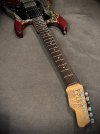
But you need time to adjust to anything different in a musical instrument. You need to play it exclusively for a couple of weeks just to to get over mistaking familiarity for better. It’s the same with fret size and radius. Every die hard 6230 7.25” fender user I persuaded to try 12” and 6100 did it to prove me wrong and every one is still using it

They all thought they couldn’t wait to get back but they actually gave themselves time to get accustomed to the benefits of better grip and geometry. The owner of this was one;
View attachment 151985
A die hard vintage Fender player.
I wasn't even meaning to touch on that, just to say instead that to me the tonal difference is huge.
You can of course compensate tonally for string gauges in many ways, especially with the myriad tools Fractal owners have, but when I hear great tone, in my mind first and foremost I hear a great sounding guitar and an innate understanding of audio engineering, whether you're trained or not. The difference in tone between string gauge is very much there to me no matter what, from a player's perspective. Not that you can't get Stevie Ray Vaughan tone with 9 gauge strings, because you can! In an audience you can't tell.
To your main point, getting used to the feel of something is what practice is, whether you're getting used to a weird ass lick or getting used to a different fret size! So if you do it long enough, it won't be a big deal.
But I do think the size of your hands, your overall physical shape and fitness, and just the natural movement of your tendons and muscles matter in terms of what neck shape and pick grip promote the least obstacles to free musical expression.
And I think there's no one way for optimal playing because human bodies are just so different, and a neck and pick are best shaped to accommodate that, in an ideal world. Immediately I think about the Shawn Lane Vigier model, optimized for genius and prodigy who specs for a completely flat neck and the lowest action humanly attainable. I'm not arguing with anything that guy would choose.
On the other hand, other masters, all with access to spec out their own ideal shapes, end up going for something different, and I don't argue with them either haha!
I have no idea what different players go for in fret size, and that's one thing I'd love to understand better in my own preference. The best playing period of my life was on an Epiphone Les Paul with tiny frets, but I know for sure the reason for that was the guitar sounded beautiful, and it just inspired the hell out of me. That same guitar felt like it was breaking my wrist because of the neck heel, and it drove me straight into the arms of a piece of shit sounding superstrat that was comfortable in a million ways, but I've never played as well because I didn't feel tonally connected.
Back to your point again, you can get used to any neck, like the Enduroneck, e.g., and get used to what Ola Strandberg thinks is optimal from thumb placement, but I don't think that neck is actually the optimal grip or technique for everybody. The main thing I did when I tried a Boden was to make sure I could get around his thumb guide without feeling hindered. I could maybe get behind that idea if Ola were a master player, but like some famous guitar company founders, he is not. I could empathize more if he were an orthopaedic researcher who had done a decade of peer reviewed testing of guitarists, but he's not that either. He's just a dude who created a shape to his preference, but his company's success doesn't grant him any real objective say over what is best for guitarists.
To Tyler, I can't say anything. I've never played one, as I've never remotely been in that price range. I know they have some sort of Chinese made line in the works, so maybe I can feel one of those one day!