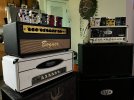
New Fractal product coming!!

Status
Not open for further replies.
I think latency is one of those things where if you see a number, it feels bad man. But if you just use the device, you can quite often get away with a lot more than you'd expect. Some electronic drumkits for instance have somewhere between 7-13ms of latency from when you first hit the pad to when you hear your first sound. Very few people complain.
Psychological effects often play a role as well.
But when I tested the first FM9 prototype in my new studio years ago, I was a bit irritated. I thought something was wrong. My good friend Thomas Blug came by and he also said that there was a lot of latency. It felt strange.

But I also approached the matter somewhat naively. First of all, I had connected the FM9 to my RME FIREFACE with an XLR cable and I had the wrong studio monitors. As it turned out after a phone call with the manufacturer, the (very high-quality) monitors have a total latency of 6 ms. This is partly due to the conversion but also to the elaborate FIR filters. But that is not a reduction in quality. These monitors were developed for monitoring. Who would think that guitarists use them as FRFR?

So the chain looked like this: Guitar -> AD -> FM9 -> DA -> AD -> RME Fireface -> DA -> AD Monitor -> Digital Crossover and FIR Filtering -> DA- Speaker. The RME added about 3-4 ms and the monitors 6 ms. In total, it was over 12 ms. And I can feel that. There is a reason why there are no digital (or only a few) professional in-ear monitoring systems. The industry standard is analog (Sennheiser ew IEM).

How did I approach this? First of all, the monitors were sold and replaced with very high-quality analog monitors without DSP (PSI AUDIO A21). FM3, FM9 and AXE FX III are connected to the Fireface via SPDIF and AES respectively.

Now the chain looks like this: Guitar - AD -> AXE FX III -> AES OUT -> FIREFACE -> DA-> Monitor Speaker. Perfect. ;-)
Live, on the other hand, I usually use in-ear monitors and a digital transmitter. The Sennheiser ew-D adds a latency of 1.8 ms.
But now the signal goes into a digital console that also adds latency and is sent back to my in-ear. In our case, it is usually a Digico S31 console that runs at a 96khz sample rate. This keeps the latency as low as possible. But thanks to in-ear monitoring, the space from the guitar cabinet/wedge to the ear is eliminated, as is the natural latency, so that overall the playing feel is absolutely direct, as you are used to.


In this respect, I don't understand why manufacturers can't manage to build digital inputs and outputs into their devices.
When the FX8 was first released (I'm still a huge fan of this device), it didn't have any digital I/O. That wasn't necessary, since it was designed to work with analog devices. But times have changed.

By the way, when I occasionally ask my drummers if it would be okay for them to play electronic drums at special shows, I only get contemptuous looks.
 
I think it's less due to the feel of the amp or boom at full volume (who still does that today) but more to no or bad experiences with other modelers or never tried a normal cab with Celestion FRLR 12" speakers. This leads to digital effect unit on the tube amp. Really a full analog tube sound ... :fearscream: TheRedDevil - Gen X ;)
 
Last edited:
Psychological effects often play a role as well.
But when I tested the first FM9 prototype in my new studio years ago, I was a bit irritated. I thought something was wrong. My good friend Thomas Blug came by and he also said that there was a lot of latency. It felt strange.

But I also approached the matter somewhat naively. First of all, I had connected the FM9 to my RME FIREFACE with an XLR cable and I had the wrong studio monitors. As it turned out after a phone call with the manufacturer, the (very high-quality) monitors have a total latency of 6 ms. This is partly due to the conversion but also to the elaborate FIR filters. But that is not a reduction in quality. These monitors were developed for monitoring. Who would think that guitarists use them as FRFR?

Interesting! What monitors were those? Personally I'd never use monitors that impart such latency. I'm guessing they had some built in DSP room correction type mechanism that was the source?

You are of course correct in that latency is often cumulative. The thing is, as soon as you stick a few digital pedals on your board, you're in that land regardless of the brand; single Boss stomps will eventually add up too. I should measure that actually.

By the way, when I occasionally ask my drummers if it would be okay for them to play electronic drums at special shows, I only get contemptuous looks.
I can't remember the year, but at some point before 2019 I was told that e-kits had outsold acoustic kits annually. I'd have to go and dig out the source. E-kits are pretty big in certain sectors. Definitely not the touring pop/rock/metal crowd, and definitely not your local jazz club, but more theatre and church based stuff, e-kits do very well there.
 
I think it's less due to the feel of the amp or boom at full volume (who still does that today) but more to no or bad experiences with other modelers or never tried a normal cab with Celestion FRLR 12" speakers. This leads to digital effect unit on the tube amp. Really a full analog tube sound ... :fearscream: TheRedDevil - Gen X ;)
I'm a millennial (just about!) and I still think valve amps are the gold standard!
 
Interesting! What monitors were those? Personally I'd never use monitors that impart such latency. I'm guessing they had some built in DSP room correction type mechanism that was the source?

You are of course correct in that latency is often cumulative. The thing is, as soon as you stick a few digital pedals on your board, you're in that land regardless of the brand; single Boss stomps will eventually add up too. I should measure that actually.


I can't remember the year, but at some point before 2019 I was told that e-kits had outsold acoustic kits annually. I'd have to go and dig out the source. E-kits are pretty big in certain sectors. Definitely not the touring pop/rock/metal crowd, and definitely not your local jazz club, but more theatre and church based stuff, e-kits do very well there.
It is also big for beginners whose kits are bought by parents saving money and space and like the idea of more quiet. I would be curious to see how they stand sales-wise with higher-end pro kits and get the lower-cost beginner kits removed from the equation. I probably have close to 14k into my kit between the cymbals rack and kit and snares. So an ekit can be more economical.
 
I think the problem are the speakers, not the AXE FX. I had to learn that too. Fortunately, thanks to the forum, it went quickly.
Absolutely, the interaction and speakers are a big part it AITR. Volume and I use my PS100 for that. That said the need for the AITR is not a must the fractal just through my headphones is excellent. Once you get to recorded music all the things that make a tube amp rock in a room are gone. Recorded the difference is so small as to be more of a color than a quantitative. Like using a slightly different IR. Like I've said I am such an amp whore Fractal gives me all the amps I would never be able to afford!
 
I don't think the reason that FX8 didn't sold well is related with the fact that there's no market for it.
There's waaaay more amp users than modeling/profilers users.
Every single one of them would 100% be looking at a decently sized and priced multi effects unit.
I never looked twice at an FX8 simply due to the size of it.
Might not be too big for the occasional gig or for a home studio but for a weekend warrior certainly is (it's one more bag/one more trip to the car - that adds up)
And I have spent quite a bit of money trying several of the smaller ones available in the market.
I bet Line 6 is doing quite well with the smaller effects units they have.
 
Interesting! What monitors were those? Personally I'd never use monitors that impart such latency. I'm guessing they had some built in DSP room correction type mechanism that was the source?
I don't want to name the company. But their monitors are used in many studios and TV/radio stations around the world.
Latency is not a problem for mixing and mastering. All monitors that have a DSP built in add latency.
Through conversion, crossover and filtering to equalize the phases.
You only have to look in the manual of your monitors to find out whether a DSP is installed.

Analog monitors require more work to develop and adjust. Unfortunately, this makes them expensive.

Translated with www.DeepL.com/Translator (free version)
 
I don't think the reason that FX8 didn't sold well is related with the fact that there's no market for it.
There's waaaay more amp users than modeling/profilers users.
Every single one of them would 100% be looking at a decently sized and priced multi effects unit.
I never looked twice at an FX8 simply due to the size of it.
Might not be too big for the occasional gig or for a home studio but for a weekend warrior certainly is (it's one more bag/one more trip to the car - that adds up)
And I have spent quite a bit of money trying several of the smaller ones available in the market.
I bet Line 6 is doing quite well with the smaller effects units they have.

The FX8 was meant to be an all-in-one pedal board replacement. It is about the size of a smaller pedal board.

I do agree that there seems to be very little market for a Fractal Audio effects only unit. The purists who want an amp on stage are probably the same people who would rather have the physical controls to allow real time adjustments that traditional pedals offer. Most of those players do not want to program a unit that requires paging through menus an.

The players who are okay with the idea of programming a complex effects unit and using digital gear are likely the exact same players who could be convinced to go all in on amp modeling. That was my path; I bought the FX8 because I wanted a really good delay unit for use with my tube amp. I was so impressed by the deep parameter control, the quality of the hardware, and the tones that I bough the Axe-FX III.
 
Thats's right, but they should better buy an all in one solution.

Nothing is stranger to me than other people playing arbiter of what other people should buy with their money, or what kind of gear they should use.

Outside of the cabs, everything on top of them is stuff I bought last year, after owning an AxeFX and FM9 for years.
IMG_6476.jpeg

It had nothing to do with what my thoughts on modeling vs tube amps or anything, I just like gear. I generally have my FM9 in 4CM with any one of the amps, but I’d prefer a much smaller footprint and the FM3 most likely won’t have the juice I want because a good chunk of it is dedicated to amp modeling. For my amp rigs, a smaller, effects-only unit would be the goldilocks. I could get an HXFX, but I love Fractal gear and would much, much prefer something made by Fractal.
 
I could get an HXFX, but I love Fractal gear and would much, much prefer something made by Fractal.
I'm now at the point where every brand pretty much has some effects on offer that I'd like access to. QC actually has some really good stuff - the Boss drive pedals are great, the delays are good, as are the reverbs. The Freeze effect is a particular favourite right now too. I think they've done it better than the other brands.

Helix has Cosmos Echo, Transistor Tape, Adriatic Delay, and Glitch Delay. These all sound really unique to me and are well worth the cost of entry.

Fractal has so many great delays and reverbs too. Cumulonimbus is probably one of my top 5 reverb algorithms.
 
This forum is crowded with guitarists with electric guitars. How about a unit with a mic input and option to go into an fx loop or plug in an acoustic guitar/bass/banjo/keyboard. There are tons of musicians who don't use amplifiers and speakers for extra colour - or already have that covered without any desire for a 300 amp rabbit hole 🙂
I would love a fractal unit focused on acoustic and/or vocals!
 
The FX8 was meant to be an all-in-one pedal board replacement. It is about the size of a smaller pedal board.

I do agree that there seems to be very little market for a Fractal Audio effects only unit. The purists who want an amp on stage are probably the same people who would rather have the physical controls to allow real time adjustments that traditional pedals offer. Most of those players do not want to program a unit that requires paging through menus an.

The players who are okay with the idea of programming a complex effects unit and using digital gear are likely the exact same players who could be convinced to go all in on amp modeling. That was my path; I bought the FX8 because I wanted a really good delay unit for use with my tube amp. I was so impressed by the deep parameter control, the quality of the hardware, and the tones that I bough the Axe-FX III.

Thats exactly what happened with me as well. I ran my XL+ alongside my FX8 in stereo with 2 x Mesa Mark V amps for a while and then went all-in with digital. I still don't use any outboard gear, just the FX3 and the FC12.
 
The FX8 was meant to be an all-in-one pedal board replacement. It is about the size of a smaller pedal board.

I do agree that there seems to be very little market for a Fractal Audio effects only unit. The purists who want an amp on stage are probably the same people who would rather have the physical controls to allow real time adjustments that traditional pedals offer. Most of those players do not want to program a unit that requires paging through menus an.

The players who are okay with the idea of programming a complex effects unit and using digital gear are likely the exact same players who could be convinced to go all in on amp modeling. That was my path; I bought the FX8 because I wanted a really good delay unit for use with my tube amp. I was so impressed by the deep parameter control, the quality of the hardware, and the tones that I bough the Axe-FX III.
100% agree with what you say above. When I used amps it was almost always with a digital multieffects solution because I just could not build a board that both had everything I needed and had the flexibility and lack of noise/cabling/power issues that a digital MFX has.

When I ran this way, I used a couple of different devices. Various Line6 solutions like the M13, HD500, and eventually Helix. Boss GT-10 or GT-100. And a Fractal FX-8. I mostly gravitated toward the GT-10 and used that for years.

For the brief time that I used the FX-8 I absolutely hated it. It was just a complete pain in the ass to dial in when contrasted with the other options. It sounded okay, but I got instant gratification with the other options. If I was going to use a digital MFX, it needed to be simple to dial in.

I was already a modeling user with the AX-8 and Axe-Fx at that point. It wasn't until the Helix got more mature along with the release of the Axe-III and eventually FM units that I went all in on modeling and ditched amps altogether. My point being yours: the folks willing to go the route of a digital effects solution with real amps are probably the same audience as those willing to go full modeling anyway. If I were to use a real amp today, it would be with my FM3 or FM9.
 
Last edited:
Here's my question about this new unit, if it is indeed a "FX" type of device. Why SPDIF? The FX-8 didn't have SPDIF. And what about things like relay switching? There's not a lot going on in the back of that unit that would lead me to believe there's much more than a couple of inputs and outputs. I'm wondering if this is a device of a different purpose that also just happens to have a few effects.

Is it possible that this is some kind of floor based amp load box with a few effects? It would make sense why one would want to use "chorus and delay" with it because then you could have stereo chorus and delay with a mono amp head...
 
Status
Not open for further replies.
Back
Top Bottom