How can I make amp models more... punchy?

OpenAI is absolutely capable of taking disparate bits of information and inferring something from them.
That's a given.

But the inference might just be mindless babble because the AI has a hard time telling truth from fiction.

And therein lies the problem. Today's hallucinations become tomorrow's training sets, leading ultimately to to model collapse. Kinda like social media today :).
Yep.
 
And therein lies the problem. Today's hallucinations become tomorrow's training sets, leading ultimately to model collapse. Kinda like social media today :).
Kinda like social media, broadcast media... aiii...don't get me started.

I think it's time to roll back my thread hijack a bit...
 
Try using a compressor. It's a very common misconception that compressors "reduce dynamic range" but this isn't inherently true. Try this: stick a compressor after the amp block and set the attack to something slow like 100ms. Set the ratio high then start playing muted strings on your guitar at, say, quarter notes at around 120bpm; you want to play something staccato that will trigger the compressor then allow it to come back to unity gain. Turn the threshold down until you're getting like 15db of gain reduction. These settings, while not at all musical, will emphasize the fact that a compressor can actually increase dynamic range because you're using the attack settings to make the initial transient loud relative to when leveling is happening. This is what gives lots of tones a characteristic "pop" on recordings in such varied genres as funk, country, and downtuned metal.

From here you can adjust the attack time, knee, and ratio to your liking to sculpt the guitar's transient relative to its sustain. Once you have it where you want it all you have to do is figure out the release so that it doesn't pump aggressively.

I agree - a post-cab compressor, set right will make an amp punch out of a speaker. it’s the sound of 70’s rock. The new JFET studio compressor is perfect for that. 4:1 ratio, aim for -2db average compression - Threshhold in the -33 area +/- to get to average -2db… set to Line level (post amp) and you’ll have to put the Output Level at -5 or so. Try slower attack at 30-60ms (let pick attack through before compression starts) and release between 75ms and 200ms. Just a starting place.
 
Last edited:
There are multiple ways one could express that thought I suppose, but that seems like a pretty clear way to say this issue is especially important in modelers that simulate power amp behavior.
I see your point, and I’m willing to grant a “maybe” here.

...OpenAI is absolutely capable of taking disparate bits of information and inferring something from them.
True. But to execute a feat like this, it would have to complete the equivalent of a one-year college-level course in circuit analysis and understand what it read, derive the correct mesh or node equations, solve those equations, and understand how human ears would respond to the output when fed through speakers. Based on what I've seen from AI so far, that's a heavy lift. ;)
 
I agree - a post-cab compressor, set right will make an amp punch out of a speaker. it’s the sound of 70’s rock. The new JFET studio compressor is perfect for that. 4:1 ratio, aim for -2db average compression - Threahhold in the -33 area +/- to get to avearge -2db… set to Line level (post amp) and you’ll have to put the Output Level at -5 or so. try attack at 30-60ms (let pick attack through) and release between 75ms and 200ms. just a starting place.

There's a string of Scorpions albums that are exemplary of this sound. "Animal Magnetism" and "Blackout" come to mind; I'd argue that the latter sounds more natural while the former is a bit more ham-fisted because the attack is too quick and the knee more obvious.
 
Hey so did you fool around in the speaker section of the amp block? Try changing the impedance curve?
Speaker drive?
Maybe someone else suggested this but the Chat GTP posts had me speed scrolling, lol.
 
Yes on speaker impedance curve. Also input dynamics. Some more high mids. Reevaluated the IR I was using.
 
Getting really close. Sounds like the amp has a bit more low end thump though (assuming the amp is first in that comparison clip).
 
Try using a compressor. It's a very common misconception that compressors "reduce dynamic range" but this isn't inherently true. Try this: stick a compressor after the amp block and set the attack to something slow like 100ms. Set the ratio high then start playing muted strings on your guitar at, say, quarter notes at around 120bpm; you want to play something staccato that will trigger the compressor then allow it to come back to unity gain. Turn the threshold down until you're getting like 15db of gain reduction. These settings, while not at all musical, will emphasize the fact that a compressor can actually increase dynamic range because you're using the attack settings to make the initial transient loud relative to when leveling is happening. This is what gives lots of tones a characteristic "pop" on recordings in such varied genres as funk, country, and downtuned metal.

From here you can adjust the attack time, knee, and ratio to your liking to sculpt the guitar's transient relative to its sustain. Once you have it where you want it all you have to do is figure out the release so that it doesn't pump aggressively.

Yeah the attack and release characteristics of the compressor can make a huge difference in the overall feel. A slower attack can let the initial pick attack of the note punch through more even though the rest of the signal might get squashed down in comparison. That can make it sound even more punchy.
 
Most AI regurgitates content it snagged off wherever it was allowed to sack and pillage so it's subject to GIGO because there's too much bad and inaccurate information out there.

To quote Mr. Burns..."you people don't think....you regurgitate!"

There are many good tips in this thread, and one I can add is that it's worth doing a deep-dive into the Input Block Noise Gate and getting it setup as transparently as you can. Maybe try your tones with the gate disabled and see if that helps any. Given that the Input Block is first in line, if the gate isn't setup right the 'error' will carry through the entire chain. Incorrect settings here can really affect transients/punch/dynamics, etc. right off the bat.
 
What has worked for me with the Plexi 100:
  • turn up speaker compression, drive, and thump, to taste.
  • turn down Supply Sag to get the overall level of compression and punch where I want it.

Those speaker parameters really do some fun things to the tone and feel that other forms of compression don’t.
 
I agree - a post-cab compressor, set right will make an amp punch out of a speaker. it’s the sound of 70’s rock. The new JFET studio compressor is perfect for that. 4:1 ratio, aim for -2db average compression - Threahhold in the -33 area +/- to get to avearge -2db… set to Line level (post amp) and you’ll have to put the Output Level at -5 or so. try attack at 30-60ms (let pick attack through) and release between 75ms and 200ms. just a starting place.
+1. Works great
 
OK, did a more thorough survey of speaker impedance. Currents faves:
1x12 G12T-75
2x12 5153 Stealth
2x12 Recto
Hipower Lindsey B
Load Box LB2 UK

Altogether it's VERY subtle, with some being noticeably not what I want.
I use a similar signal chain, Guitar > FM9 In 1 > FM9 Out 3 > Archon > Suhr RL > FM9 In 2 > Cab + ...

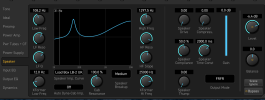
This is the SIC I'm using. Suhr noted that they wanted the IC of a greenback cab and theSuhr RL IC curves I've seen had LF & HF parameters different from the Fractal UK LB curve with LF at 108 and a slightly higher HF frequency and higher LF & HF resonance. I also turned off Speaker Drive, Compress & Thump but these can be adjusted to taste.

Screenshot 2025-03-25 at 3.00.26 PM.png
 
Last edited:
I gigged an Archon for a couple of years. Cool amp!

I'l have to take a look at where drive and impress are set.
 
I use a similar signal chain, Guitar > FM9 In 1 > FM9 Out 3 > Archon > Suhr RL > FM9 In 2 > Cab + ...

This is the SIC I'm using. Suhr noted that they wanted the IC of a greenback cab and theSuhr RL IC curves I've seen had LF & HF parameters different from the standard Fractal GB cabs. I also turned off Speaker Drive, Compress & Thump

View attachment 152623
Tried it and lowering Drive and Compress really can make it scary stiff. Big difference even when you change them a dB or 2.
 
Tried it and lowering Drive and Compress really can make it scary stiff. Big difference even when you change them a dB or 2.
I'll give that a try. I'd been setting those to zero on Justin York's recommendation, but clearly it's all to taste and ears don't lie.
 
I agree - a post-cab compressor, set right will make an amp punch out of a speaker. it’s the sound of 70’s rock. The new JFET studio compressor is perfect for that. 4:1 ratio, aim for -2db average compression - Threshhold in the -33 area +/- to get to average -2db… set to Line level (post amp) and you’ll have to put the Output Level at -5 or so. Try slower attack at 30-60ms (let pick attack through before compression starts) and release between 75ms and 200ms. Just a starting place.

Thanks for this...I've been wanting to explore post-amp compression for doing just that but never seemed to get around to it.

I used the FM9's "FF Studio Comp" and played around with your starting settings earlier this week and thought I'd try it out at this weekend's gig, putting the Compressor on a footswitch "just in case". I found ~40ms attack and ~80ms release to be a good starting point.

I really liked it for certain tones at the show tonight...suitably tweaked the post-amp comp really seems to clarify tones overall and does make for some nice, clear, punchy articulation. I toggled it on/off throughout the night using various tones/gain levels and liking what it adds...it does bring things more "forward" for sure....thanks again for the inspiration...!
 
Back
Top Bottom