Dialing OUT the digital Axe-Fx midrange

Status
Not open for further replies.

drawn

Member
Hey everyone,

Axe-Fx III user, latest update. I know the title will upset many users here, but there we go! :)

First off: I think the Axe-Fx sounds amazing for clean and low gain tones. But go into higher gain territories and it falls apart quite quickly.
I'm always having a very ugly, nasal sounding midrange (500 - 1500 hz) with anything in the Axe-Fx that involves high gain. Every amp has it. It's almost as if this is the sound of Fractal Audio Systems. It's not good at all though. It's not how an actual amp sounds when being mic'd, it's not how the Kemper or how many amp plugins out there sound. It's now what my 5150 or my Archon or Dual Rectifier sound through my cabs and various mics. It's really only the Axe-Fx that has it. It makes every tone sound very 2D, nasally, dark, digital and not tight. Reminds me a bit of POD Farm, but let's not be too harsh here....... ;-)

So I thought: Maybe it's just the IRs? I have about a million third party IRs though and I'm very pick with IRs - they all have that problem. So it's not really in the IRs. To make you understand what I'm talking about, here are two videos which perfectly show what I mean:

(Unit #1 is Kemper, #2 is the Axe-Fx).

(Starting at 2:50 - 1 is the Kemper and 2 is the Axe-Fx)

As you can hear: The Axe-Fx sounds super midrange-y, boxy and dark in comparison to the Kemper. Way too much though and it doesn't sit in the mix at all. The Kemper sounds like how my real amps and mic'd cabs sound like. You try to EQ that midrange out from the Axe-Fx tones, but then you took out the body and a lot of the meat of the tone. So it's not an EQ thing, it's something in the way the Axe-Fx sounds, but I'm sure it can be solved somehow, but I haven't found it out yet.

Turning down the "mids" on the amp will kill the amp's tone very quickly, so that's no option. It needs mids, but not this 800-1500 hz bark. Using the Amp EQ will kill the amp's sound as well and doesn't solve it either (I've tried it, it just scoops things and will make tones sound "hollow". Not a lot of control there anyway..). Post-EQ does the same obviously and multi-band EQ makes it sound weird and kills the dynamics as well if you start tackling the midrange. I don't understand why I need to do a ton of processing every time I try to use the Axe-Fx. It's a frustrating battle. Nothing like this happens when using the Kemper or real amp + cabs (or even plugins).

Are there any settings in the amp or in the cab block to make this midrange honk go away? I might have overseen something, who knows.
I'm more than happy to learn from experienced users who CAN help. If you're a beginner yourself or not really into the high gain modern metal type of tones, please don't try to help me (not trying to come across in a harsh way, but it's a very specific thing and it needs specific advice).

Best,
Drawn

______________________


Also, I'd love to make a few things clear, before I get "beginner tips" (sorry for that!) and before things go off-topic:

  • I do have a properly tuned and treated studio (done by a professional) with great monitoring (and headphones)
  • I've been playing the guitar for 30 years and I'm more than above average and a very technical player, so it's not my playing or my guitars or pickups or whatever people come up these days :-)
  • I do have a lot of experience in mixing and mastering (I professionally run a studio)
  • I don't need to hear how happy you are with your tones or that I need to use EQ. ;-P Tones have to sound right at the source - that's what every great producer and mixing engineer will tell you.
  • I don't need to hear "the Axe-Fx isn't for you then". Because I truly believe it is. And I don't want a Kemper (again) - the Kemper has its own flaws. I wish I didn't sell it though.....
 
Last edited:
Interestingly, there have been many through the years commenting on a certain mid push from the Kemper that can't be dialed out. In the video above, the Kemper does sound like it has more midrange than the Fractal, but either unit has the means to accentuate or attenuate any frequencies that you want (I have both a Kemper and a Fractal).
 
Interestingly, there have been many through the years commenting on a certain mid push from the Kemper that can't be dialed out. In the video above, the Kemper does sound like it has more midrange than the Fractal, but either unit has the means to accentuate or attenuate any frequencies that you want (I have both a Kemper and a Fractal).

I have both as well and am exclusively a high gain player, and while they each have a different midrange, there definitely is a somewhat boxy "firmness" to the Axe FX when I compare them, or compared to my real amp. I prefer the Axe FX for its flexibility among other reasons, but I do have to cut 500 and 1000 in the post amp EQ in just about every single preset I make to counteract this.

For the record overall though, my Kemper still replicates my real 5153 better than I've been able to with my Axe, but I'm working on it.
 
Interestingly, there have been many through the years commenting on a certain mid push from the Kemper that can't be dialed out. In the video above, the Kemper does sound like it has more midrange than the Fractal, but either unit has the means to accentuate or attenuate any frequencies that you want (I have both a Kemper and a Fractal).
It's not just a comment, in the older Kemper firmware there was a repeatable, measurable bump in certain frequencies. Some people liked it. I think they worked it out in new code. As long as it sounds and feels good, it is good imho!

I am not trying to be exactly anything but me. Profiling other people's tones is fun but creatively a dead end imho. Modeling whole amps gives us a full palette.
 
I have both as well and am exclusively a high gain player, and while they each have a different midrange, there definitely is a somewhat boxy "firmness" to the Axe FX when I compare them, or compared to my real amp. I prefer the Axe FX for its flexibility among other reasons, but I do have to cut 500 and 1000 in the post amp EQ in just about every single preset I make to counteract this.

For the record overall though, my Kemper still replicates my real 5153 better than I've been able to with my Axe, but I'm working on it.

The eighties are my wheelhouse, so that's the sound(s) I tend to gravitate to.
 
Yeah, I have fought with this for years. I almost always lower the 500hz slider on the output EQ on every sound.

Another idea that helps is run a filter or parametric EQ before the amp with a cut around 400hz to 500hz. Maybe about -4db. This can help clean up the sound, but too much can get too cocked-wah and clanky. Gotta find the balance.
 
Do you have Axe FX connected via USB or from the output to audio interface? I have noticed that when I'm doing recordings with Axe FX, using the USB sounds like in your video. When recording from the Axe output into an external audio interface it sounds more natural in the midrange. Maybe my settings are off... No idea 😊
 
I have both as well and am exclusively a high gain player, and while they each have a different midrange, there definitely is a somewhat boxy "firmness" to the Axe FX when I compare them, or compared to my real amp. I prefer the Axe FX for its flexibility among other reasons, but I do have to cut 500 and 1000 in the post amp EQ in just about every single preset I make to counteract this.

For the record overall though, my Kemper still replicates my real 5153 better than I've been able to with my Axe, but I'm working on it.
I love my Fractal gear, but I have been really into ToneX lately for some of these reasons.
 
EDITED :
After reading your past posts, I regret trying to help you.

Cliff's kind explanations and tips seem to be too valuable for you.

Put your fractals up for sale today and use Kemper.

I used Kemper for a year in 2014 and took it to a rock festival and recorded.

The gear has some kind of "profiling" thing, but when you listen to it, the main sweet spot band is ugly and distorted, and the moment you turn the knob on the front like G/B/M/T/P knobs to adjust it, it gets even more horribly distorted.

Some people cheer that the device sounds like an amplifier. I raise my middle finger.
Before you start asking for help and adding all sorts of tricky and absurd demands, I think it would be a good idea to learn how to show respect to the legends and gurus of this forum. 🤤 🤘


But when I read your past writings, it seems like you NEVER learn.
================================================================================
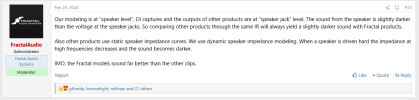
Well, maybe this will help the original poster understand the relatively dark sound of Fractal Audio Systems.

speaker level.png

Also, it might be helpful to use Cliff's old tip (instead of using cab blocks) by slightly refining it.

For your convenience/try , I'll attach a pre-set block file. Just put it in the correct folder location, place 1 filter block, 1 GEQ block, and load these files from the library, and you're basically ready to go.

oh , and It might also be helpful to mix it with existing dynacab or legacy IR cab blocks.
.
.

cliff said :

"Try this:
Make a patch with no cab block.
After the amp put a Filter block. Reset to make sure all parameters are at default values.
Set the type to Lowpass.
Set the Order to 4th.
Set the Freq to ~5000.
Set the High Cut Freq to ~5000.
Adjust the Freq and High Cut Freq to taste. For more aggressive tones increase both to 6000 or so. For warmer tones decrease both to 4000 or so.
Now, to add some "character" put a Graphic EQ or Parametric EQ block after (or before) the Filter block. Boost 125 Hz a little. Play around with some of the midrange and upper midrange bands to change the character of the tone. This is what I used:
31: 0.0
63 Hz: 0.6
125 Hz: 4.57
250 Hz: 0.25
500: 0.0
1K: -5.0
2K: -2.27
4K: 1.95
8K: -1.0
16K: -5.77
The reasoning behind this is that there is no such thing as a "flat" speaker. All speakers, even really expensive monitors have peaks and dips in the response. That's why they all sound different. The primary thing a guitar speaker does is roll off the highs aggressively at somewhere between 4K and 6K Hz. The Filter block replicates the rolloff but lets the natural response of the speaker come through. "
 

Attachments

Last edited:
Well, maybe this will help the original poster understand the relatively dark sound of Fractal Audio Systems.

View attachment 155548

Also, it might be helpful to use Cliff's old tip (instead of using cab blocks) by slightly refining it.

For your convenience/try , I'll attach a pre-set block file. Just put it in the correct folder location, place 1 filter block, 1 GEQ block, and load these files from the library, and you're basically ready to go.

oh , and It might also be helpful to mix it with existing dynacab or legacy IR cab blocks.
.
.

cliff said :

"Try this:
Make a patch with no cab block.
After the amp put a Filter block. Reset to make sure all parameters are at default values.
Set the type to Lowpass.
Set the Order to 4th.
Set the Freq to ~5000.
Set the High Cut Freq to ~5000.
Adjust the Freq and High Cut Freq to taste. For more aggressive tones increase both to 6000 or so. For warmer tones decrease both to 4000 or so.
Now, to add some "character" put a Graphic EQ or Parametric EQ block after (or before) the Filter block. Boost 125 Hz a little. Play around with some of the midrange and upper midrange bands to change the character of the tone. This is what I used:
31: 0.0
63 Hz: 0.6
125 Hz: 4.57
250 Hz: 0.25
500: 0.0
1K: -5.0
2K: -2.27
4K: 1.95
8K: -1.0
16K: -5.77
The reasoning behind this is that there is no such thing as a "flat" speaker. All speakers, even really expensive monitors have peaks and dips in the response. That's why they all sound different. The primary thing a guitar speaker does is roll off the highs aggressively at somewhere between 4K and 6K Hz. The Filter block replicates the rolloff but lets the natural response of the speaker come through. "
Here and here are the links to those comments for those that want to read the full thread context.
 
Just to clarify, are you saying that you did not use the exact same IR for both units when you recorded the comparison video?
 
Yeah, I have fought with this for years. I almost always lower the 500hz slider on the output EQ on every sound.

Another idea that helps is run a filter or parametric EQ before the amp with a cut around 400hz to 500hz. Maybe about -4db. This can help clean up the sound, but too much can get too cocked-wah and clanky. Gotta find the balance.

I was beginning to wonder if my hearing is whack because I make the same cuts every time too lol
 
To be fair:
Hey everyone,

Axe-Fx III user, latest update. I know the title will upset many users here, but there we go! :)

First off: I think the Axe-Fx sounds amazing for clean and low gain tones. But go into higher gain territories and it falls apart quite quickly.
I'm always having a very ugly, nasal sounding midrange (500 - 1500 hz) with anything in the Axe-Fx that involves high gain. Every amp has it. It's almost as if this is the sound of Fractal Audio Systems. It's not good at all though. It's not how an actual amp sounds when being mic'd, it's not how the Kemper or how many amp plugins out there sound. It's now what my 5150 or my Archon or Dual Rectifier sound through my cabs and various mics. It's really only the Axe-Fx that has it. It makes every tone sound very 2D, nasally, dark, digital and not tight. Reminds me a bit of POD Farm, but let's not be too harsh here....... ;-)

So I thought: Maybe it's just the IRs? I have about a million third party IRs though and I'm very pick with IRs - they all have that problem. So it's not really in the IRs. To make you understand what I'm talking about, here are two videos which perfectly show what I mean:

(Unit #1 is Kemper, #2 is the Axe-Fx).

(Starting at 2:50 - A is the Kemper and B is the Axe-Fx)

As you can hear: The Axe-Fx sounds super midrange-y, boxy and dark in comparison to the Kemper. Way too much though and it doesn't sit in the mix at all. The Kemper sounds like how my real amps and mic'd cabs sound like. You try to EQ that midrange out from the Axe-Fx tones, but then you took out the body and a lot of the meat of the tone. So it's not an EQ thing, it's something in the way the Axe-Fx sounds, but I'm sure it can be solved somehow, but I haven't found it out yet.

Turning down the "mids" on the amp will kill the amp's tone very quickly, so that's no option. It needs mids, but not this 800-1500 hz bark. Using the Amp EQ will kill the amp's sound as well and doesn't solve it either (I've tried it, it just scoops things and will make tones sound "hollow". Not a lot of control there anyway..). Post-EQ does the same obviously and multi-band EQ makes it sound weird and kills the dynamics as well if you start tackling the midrange. I don't understand why I need to do a ton of processing every time I try to use the Axe-Fx. It's a frustrating battle. Nothing like this happens when using the Kemper or real amp + cabs (or even plugins).

Are there any settings in the amp or in the cab block to make this midrange honk go away? I might have overseen something, who knows.
I'm more than happy to learn from experienced users who CAN help. If you're a beginner yourself or not really into the high gain modern metal type of tones, please don't try to help me (not trying to come across in a harsh way, but it's a very specific thing and it needs specific advice).

Best,
Drawn

______________________


Also, I'd love to make a few things clear, before I get "beginner tips" (sorry for that!) and before things go off-topic:

  • I do have a properly tuned and treated studio (done by a professional) with great monitoring (and headphones)
  • I've been playing the guitar for 30 years and I'm more than above average and a very technical player, so it's not my playing or my guitars or pickups or whatever people come up these days :-)
  • I do have a lot of experience in mixing and mastering (I professionally run a studio)
  • I don't need to hear how happy you are with your tones or that I need to use EQ. ;-P Tones have to sound right at the source - that's what every great producer and mixing engineer will tell you.
  • I don't need to hear "the Axe-Fx isn't for you then". Because I truly believe it is. And I don't want a Kemper (again) - the Kemper has its own flaws. I wish I didn't sell it though.....

Is your observation applicable to the up-to-date FW? As the Youtube videos were made in 2020, I doubt if they represent the actual experience with FAS devices with current FW.

Well, maybe this will help the original poster understand the relatively dark sound of Fractal Audio Systems.

View attachment 155548

Also, it might be helpful to use Cliff's old tip (instead of using cab blocks) by slightly refining it.

For your convenience/try , I'll attach a pre-set block file. Just put it in the correct folder location, place 1 filter block, 1 GEQ block, and load these files from the library, and you're basically ready to go.

oh , and It might also be helpful to mix it with existing dynacab or legacy IR cab blocks.
.
.

cliff said :

"Try this:
Make a patch with no cab block.
After the amp put a Filter block. Reset to make sure all parameters are at default values.
Set the type to Lowpass.
Set the Order to 4th.
Set the Freq to ~5000.
Set the High Cut Freq to ~5000.
Adjust the Freq and High Cut Freq to taste. For more aggressive tones increase both to 6000 or so. For warmer tones decrease both to 4000 or so.
Now, to add some "character" put a Graphic EQ or Parametric EQ block after (or before) the Filter block. Boost 125 Hz a little. Play around with some of the midrange and upper midrange bands to change the character of the tone. This is what I used:
31: 0.0
63 Hz: 0.6
125 Hz: 4.57
250 Hz: 0.25
500: 0.0
1K: -5.0
2K: -2.27
4K: 1.95
8K: -1.0
16K: -5.77
The reasoning behind this is that there is no such thing as a "flat" speaker. All speakers, even really expensive monitors have peaks and dips in the response. That's why they all sound different. The primary thing a guitar speaker does is roll off the highs aggressively at somewhere between 4K and 6K Hz. The Filter block replicates the rolloff but lets the natural response of the speaker come through. "

Here and here are the links to those comments for those that want to read the full thread context.
Having difficulty getting it right - is it just me or the "speaker level" claim doesn't seem to address the OP's observation " It's not how an actual amp sounds when being mic'd", given that the expected behaviour for Amp block and Cab block combined is to emulate the signal coming from amps "when being mic'd"?
 
Having difficulty getting it right - is it just me or the "speaker level" claim doesn't seem to address the OP's observation " It's not how an actual amp sounds when being mic'd", given that the expected behaviour for Amp block and Cab block combined is to emulate the signal coming from amps "when being mic'd"?
+1 - unrelated in that comparing Axfx to other modellers is apples/oranges given differences in accuracy etc, but also due to Axefx uniquely modelling amp behaviour up to and including speaker interactions (speaker tab) prior to applying an IR. To make the OP's case fairly, a comparison of mic'd physical amp/cab to Axfx matching amp model with matching IR seems needed as suggested above.
 
I do find the sociology of how this guy explained his problem to be interesting. He comes in hot with "let's be honest" (were we all lying to ourselves?) saying he knows he's insulting people, then goes into a lot of detail on his issue, then wraps with, I'm an expert, don't waste my time with basic advice.

This don't be offended by my broadsides, and don't waste my time - but take my problem seriously... It's so odd I didn't know what to make of it.... is this bait for a YT video? Yet people are helping! And some say this isn't a nice forum?

A lot of helpful people here as I have always maintained. : )
 
Last edited:
First of all: Thanks for so many replies. As always, and as expected, a lot of replies that ask questions that would have been answered if they had read my post. But alas, it's the internet. :)
BUT thanks a lot to some very useful comments that understand the issue and try to suggest solutions.

Second: I'm not the guy in the video, but I can clearly replicate this very same behaviour in my setup if anybody really needs an evidence in 2025..... But I'd say the couple of comments here that said they have to take out 500hz and 1000hz every time should be enough evidence.

I find it odd that so many people always "defend" the Axe-Fx, saying it's a modeller and cannot be compared to a Kemper (which captures real amps and cabs) or an actual real amp with a cab. Isn't it what the Axe-Fx is all about? A technical explanation for why the Axe-Fx sounds dark or boxy doesn't help. It shouldn't be there to begin with or should be easy to dial out if the user wants it.

I will try to directly reply to the useful comments here to make this thread less diffuse. :)
 
Status
Not open for further replies.
Back
Top Bottom