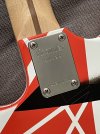
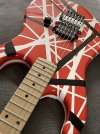
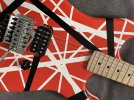
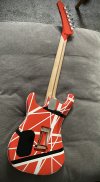
5150 build.

This is very much an analog to what Cliff does: forensic examination of components and design, meticulous reconstruction, and refinement based on real world understanding of the tonal properties of the original. You just created an analog model! Very cool concept indeed. You could create a guitar company based on that. Forget about the looks entirely; you could build creating guitars that mimic the resonance and tonal properties of famous guitars. Of course, you’d have to have had a chance to have it in the shop at some point, like this one!
 
Not being hyperbolic. That is truly a work of art. Like we had discussed before I’m not a huge fan of “relicing”, but this is absolutely IMHO a perfect example and reason for having the expertise and creative ability to distress a guitar. I was watching the show on REELZ network last night “Van Halen, The Story of Their Songs”. There were some cool shots of EVH and 5150. For whatever reason while I immediately recognized EVH’s genius, (I’ll never forget my friend popping in the Cassette in his 1969 Chevelle SS with Jensen Triaxial speakers and hearing Eruption full blast for the first time…just WOW!!) but I never became a huge Van Halen follower. I don’t know if it was the period and where I was musically. Listening to loads of Progressive and Jazz Fusion. However I always kept a close ear to what EVH was up to. Anyway, watching the show last night really solidified what an absolutely unique person and one of the greatest players ever.

BTW, didn’t watch the other (let’s exploit someone’s death) show.
 
Not being hyperbolic. That is truly a work of art. Like we had discussed before I’m not a huge fan of “relicing”, but this is absolutely IMHO a perfect example and reason for having the expertise and creative ability to distress a guitar. I was watching the show on REELZ network last night “Van Halen, The Story of Their Songs”. There were some cool shots of EVH and 5150. For whatever reason while I immediately recognized EVH’s genius, (I’ll never forget my friend popping in the Cassette in his 1969 Chevelle SS with Jensen Triaxial speakers and hearing Eruption full blast for the first time…just WOW!!) but I never became a huge Van Halen follower. I don’t know if it was the period and where I was musically. Listening to loads of Progressive and Jazz Fusion. However I always kept a close ear to what EVH was up to. Anyway, watching the show last night really solidified what an absolutely unique person and one of the greatest players ever.

BTW, didn’t watch the other (let’s exploit someone’s death) show.
Ed's playing was always a big influence on me far more than Van Halen songs ever were and his rhythm playing at least as much as the lead.
This guitar ended up a as much as a professional challenge as anything else and I seriously moved the goalposts as it went along . I ask myself "could I do a better one " and the answer wouldn't be straight forward because I could do a far more accurate one as long as it was to be the condition it is now and didn't want to actually use it. Also the cost becomes a consideration. I now have contacts that I could source 100%of the original parts but as you can expect it comes at a high price. Getting a decent set of pictures to work from is a huge task and finding better ones caused me quite some issues as I` had made incorrect judgment calls based off the poor pictures I previously had.

At the end of this process I still can't be 100% sure what the body wood was but basswood sounds right looks right and possesses the right characteristics apart from what does look like open pours. I got super close with basswood but not exactly. My paint is modern because I wanted it hard (to use it) and acrylic lacquer just isn't. I can't say what the original paint type was because it could have been spray can( paint has also changed quite a bit in the last 40 years) but most likely base coat very fragile and on 5150 soft to start with. I am pretty sure on the colour of plain white with 82 formula GMWA7753 red no prep and no clear. The rest is certain. My guitars play better than the real one which was important and the basswood one sounds correct IMO the other being slightly brighter and having the ash body tonal character.

The relic is very hard to do convincingly because a lot of the damage is paint pulled off by tape and you just can't replicate this effect with any control and my paint is bulletproof by comparison to the real one (deliberately so). Also on Ed's paint rubbed off easily leaving textured fade curtesy of a rough speckled white and the slight yellow visible in the paint as it is worn through. I could have done one that is just a visual copy with materials that would get this look more accurate but I want it to play. Also however badly done it looks in pictures it's actually far worse in person and that is also hard to copy. The slight variables are my basswood one is new hardware (cost reasons) and there are slight tonal variables in using a modern Floyd compared to the FRT5 Hanson prototype, hard paint and not Ed's broken pickup. Plus stainless frets but I can't play 6150 nickel .

The Relic sound very good and lively but not authentic acoustically for a couple of reasons; one the body is not the same resonance and it has a modern double truss rod that changes the tone compared to a vintage single in the Musikraft as I specked it. LCG don't make a neck with the single rod. I also fitted stainless 57110 frets but tried the original 10" radius (and reminded myself why this is a compromised choice.)
I could go on about this but we are on page 26 here!
Thanks for the kind words.
 
Incredible. This could just be a thesaurus on variations of “incredible” for your determination and attention to detail.
 
I just finally got around to watching the YouTube episode of Halenville on 5150.
It features contributions by many respected people and raises a few things I think I have got balance of probability quality answers too.
In fact I think I can list the who and what of the guitar entirely to this standard. I not saying that I am right but this is the best available information collected and tested as far as possible.

Parts and who did what;

Neck. ESP strat neck converted by Paul Unkert before he left Kramer in late 82. I say strat because although the beak was coming through from ESP by the time 5150 was put together 5150 neck had been done before this time . Later not converted necks with this head where not available yet and no-one else at Kramer did any conversions. This was all Unkert did .

Body. Sports Pacer prototype in basswood as part of the plan to switch from the very heavy maple production at the time.
The body was half finish sanded, no transition sanding and no preparation . The volume hole and pickup rout where done for it's use as a guitar for Ed. It was painted with available GM paint by George Felice at the same time as 1984. George also did the tape. Colour is bright white and wa7753 red with basic black. The white is a more durable acrylic than the base coat red that is supposed to be clear coated hence the soft and very fragile red.

Pickup.
Duncan JBJ but Eds tremolo picking style had forced the high E to get stuck in the coil damaging one side. This is when the white gaff tape was added to prevent it happening again. This pickup remained in until the Peavey Wolfgang pickup was fitted,(designed to copy it and Ed preferred it.)
Electrics The original pot was a sealed Bournes 82 500k solid shaft and this is the reason the guitar has the MXR (fender jazz bass ) knob instead of a strat knob. Switchcraft barrel jack.

Tuners. Gotoh OEM Schaller M6 mini copies.

String tree. Charvel .

The Floyd. was a Mike Hanson short run FRT5 Floyd Rose and nut

And last but not least Edward put it together himself.
 
Last edited:
I had not heard of the JBJ. This was news to me, and I’d love to try one back to back with the modern trembucker I have and don’t like. If these truly had a more complex character, it makes more sense to me why that pickup exploded with popularly. And now I understand the weird occurrence that the trembucker were wound the same number of turns, not slightly reduced to equal the exact resistance of the standard.
 
I had not heard of the JBJ. This was news to me, and I’d love to try one back to back with the modern trembucker I have and don’t like. If these truly had a more complex character, it makes more sense to me why that pickup exploded with popularly. And now I understand the weird occurrence that the trembucker were wound the same number of turns, not slightly reduced to equal the exact resistance of the standard.
JBJ is just a JB by MJ, slightly more open sounding than the one you get now but very similar. On Ed's one coil worked ( 8k ) and the other reads 160K so it doesn't sound like a JB and hasn't since the tape went on. The Wolfgang is pretty close if that's what you want.
 
JBJ is just a JB by MJ, slightly more open sounding than the one you get now but very similar. On Ed's one coil worked ( 8k ) and the other reads 160K so it doesn't sound like a JB and hasn't since the tape went on. The Wolfgang is pretty close if that's what you want.
Probably changed by the string getting hooked under the bobbin. Pickup windings are hair thin....
 
Back
Top Bottom