
The REAL Mesa Boogie Mark IIC++

The most significant difference I read between the IIC+ and IIC++ models is about 6dB of boost somewhere in the preamp and a 300Hz low shelf, which implies a small cathode cap probably 0.47uF on a 1.5k which is pretty much the IIC++ factory mod and the III R2 switch according to available schematics, this later became the 'Mid Gain' switch on the IV with a slightly larger value.

To emulate this difference on the IIC+ model:
1. Set Input Trim to 2.0.
2. Input EQ: Lowshelf at 300Hz -4dB.

Now you can have the benefit of all the IIC+ modes (Deep, Bright, ect.) and the perpetual updates and fixes but with the same amount of gain and tightness as the IIC++ model.

One small difference is that the standard IIC+ model has some high pass filter at some low frequency which is not present on the IIC++ or IV models.
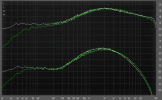
IIC++.png


An even closer option is to use the MK IV MID model.
Leave Input Trim on 1.0 because this mode already adds a large cathode cap at the correct location which adds 6dB of boost; only apply the Input EQ Lowshelf at 300Hz -4dB.
It sounds and responds pretty much identical.

IV++.png
 
Last edited:
The amount of views of this threads in insane, almost everyone arrives here via google if they search Fractal IIC++.
Also, the amount of taboo surrounding the ++ mod is large, all in all it is pretty much a single cathode cap that makes all the difference.

On a personal note, I really hate Gibson's greed, selling an entirely different amp model in limited quantities just to squeeze as much as possible from Metallica fans who play guitar.
One freaking capacitor... 😤
 
Last edited:
The most significant difference I read between the IIC+ and IIC++ models is about 6dB of boost somewhere in the preamp and a 300Hz low shelf, which implies a small cathode cap probably 0.47uF on a 1.5k which is pretty much the IIC++ factory mod and the III R2 switch according to available schematics, this later became the 'Mid Gain' switch on the IV with a slightly larger value.

To emulate this difference on the IIC+ model:
1. Set Input Trim to 2.0.
2. Input EQ: Lowshelf at 300Hz -4dB.

Now you can have the benefit of all the IIC+ modes (Deep, Bright, ect.) and the perpetual updates and fixes but with the same amount of gain and tightness as the IIC++ model.

One small difference is that the standard IIC+ model has some high pass filter at some low frequency which is not present on the IIC++ or IV models.

View attachment 157195


An even closer option is to use the MK IV MID model.
Leave Input Trim on 1.0 because this mode already adds a large cathode cap at the correct location which adds 6dB of boost; only apply the Input EQ Lowshelf at 300Hz -4dB.
It sounds and responds pretty much identical.

View attachment 157196

Thanks for the info, James. 🤘

Where did you get the information that setting Input Trim to 2.0 equals +6db of input gain?

Not doubting you at all, just want to learn how to solve for x on my own for other applications. Lol
 
The math:

dB = 20 log (Vout / Vin)

Vout / Vin = gain ratio or multiplier

Input Trim is a gain multiplier parameter so a setting of 2.0 would be a gain ratio or multiplier of 2.0 (twice as much signal)

dB = 20 log (2)
dB = 20 x 0.301
dB = 6.02

To go the other direction it would be:

Gain Ratio = 10 ^ ( dB / 20 )

That's 10 to the power of the quotient of the dB value divided by 20

Font limitation on the forum make it hard to show exponents and subscripts and such.
 
Last edited:
The official IIC++ reissue just launched which might explain some renewed interest here. But James is right to my knowledge to suggest the Mark IV MID model, as the Mid-Gain mode on the Mark IV is essentially the IIC++ mod according to people who have traced theirs.
 
The Mesa community isn’t happy at all with what they do … advertising something and saying that this is sold out 2 hours later … 200 ex, scalpers already sold them on reverb … well 😓
 
The Mesa community isn’t happy at all with what they do … advertising something and saying that this is sold out 2 hours later … 200 ex, scalpers already sold them on reverb … well 😓
Yeah scalpers always suck, but I’m seeing a lot of comments from people upset it was sold out as soon as the advertisements came up. They were open to preorders for months so some people weren’t paying attention and missed out.

I wouldn’t be surprised if Mesa does another round eventually.
 
It was a little weird that they held up announcing it until (delayed) launch, but everyone who saw them tease it at NAMM had already contacted a dealer to get on a waitlist so most were spoken for before the wider media launch even happened. It was relatively easy to get one if you saw the NAMM coverage and ordered in January but for the people who had no idea they definitely feel blindsided.

Really frustrating the number of scalpers, but when some people need to hustle to make ends meat and others are willing to overpay I guess it's unavoidable. And I've only seen ~5 out of the 200 listed so far so it might just be a small fraction.

Given the circuit board is the same base board as the IIC+ reissue they're keeping in ongoing production, it would be very easy for them to make another limited batch. Even more frustrating might be if they make a batch of switchable ones to annoy everyone who bought the first batch 😂
 
An easy way to 'demo' HRG vs DRG on the AxedFX is to run two IIC+ amps in parallel (copy & past the block with your settings), one with default 6L6GC power tubes and the other with 600B power tubes.
On Amp 2 do channel A with 6L6GC and Channel B with 300B with grid Bias at 100% for quick switching between HRG and DRG.
Also set 'Bypass Mode' to Mute for a quick 100W/60W or Simul/ClassA switching when you mute Amp1, the real amp always switches off the Pentode pair.
Look at the impedance curve on the the Speaker tab when using the 300B triode, this probably the biggest difference and what makes the DRG combination smoother sounding.
Note that doubling power tubes only boost level by 3db so you'll have to compensate by lowering both amps by -3dB compared to one amp at 0db, several presets or a combination of channels can do the trick.

@FractalAudio could probably further refine this quick tip with other settings if needed be.
 
Last edited:
Back
Top Bottom