EQ Adjustment for Hearing loss

Jim DeSchamp

Inspired
Sorry if this is not the place for this:

Basically for headphones or studio monitors.

Has anyone adjusted either output EQ or added a EQ block at the end of the chain for hearing loss (used your hearing test)? Anything going to DAW or FH will not have this adjustment. I am looking for clarity at lower volumes.

Thanks!
 
Edit:used to be able to hear a decade ago 18khz …. Now I can’t

I don’t have hearing loss but I can imagine everyone’s hearing loss is frequency dependant due to age/damage.

While HF being more common for loss , you’d have to have a professional of sort to find out how much to compensate for your use case.

You might need a High shelf boost of 10k at 3db

Another might need a high shelf at 5k for 1.5 db.


But if you’re talking about bass/treble “hearing loss” at lower volumes

That’s the concept of “countering” the fletcher munson curve, there’s multiple threads on this matter.
 
Last edited:
I don’t have hearing loss but I can imagine everyone’s hearing loss is frequency dependant due to age/damage.

While HF being more common for loss , you’d have to have a professional of sort to find out how much to compensate for your use case.

You might need a High shelf boost of 10k at 3db

Another might need a high shelf at 5k for 1.5 db.


But if you’re talking about bass/treble “hearing loss” at lower volumes

That’s the concept of “countering” the fletcher munson curve, there’s multiple threads on this matter.
Treble loss is what I am dealing with................. I had a hearing test this week
 
I can totally relate — I’ve been on the road working with audio for over 20 years. These days, I really try to avoid using headphones. But if you have to, add a high cut around 5k or so, and don’t make any other EQ adjustments. Just get used to your reference and trust your ears — even if they’re a bit worn out.
 
Treble loss is what I am dealing with................. I had a hearing test this week

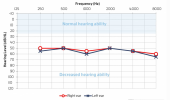
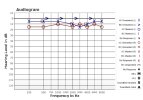
This is a typical audiogram resulting from a hearing test, with Left and Right ear graph:
2025-11-13_18h12_05.png

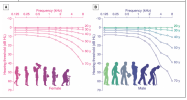
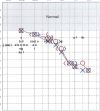
People affected by presbycusis (typically because of the age) have these typical graphs:

2025-11-13_18h21_01.png

See your own diagram and look how many DBs your loss is depending of the frequencies,
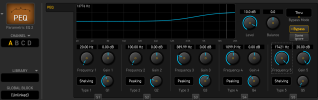
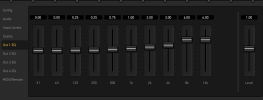
with Fractal in theory you can easily set a PEQ to build an opposite response graph, placing the block just before the OUT used for your headphones or studio monitors.
E.g. like this:

2025-11-13_19h02_57.png

However, in practice, you need to bear in mind that you could overload your headphones/monitors (e.g. damage their tweeters) or saturate high frequencies,
so if you increase high frequencies e.g. by +20db or more, I recommend that you do not set the volume too high.
That's why you can't really compensate great hearing loss, but sure do a satisfactory adjustment.

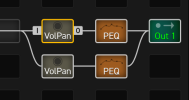
If you need separate L & R adjustments you can build a cabling similar to this:

2025-11-13_19h24_29.png

First row with VOL and PEQ set with balance full Left, the others below set full Right.

You can also ask your audiologist for advice, explaining that you have a marveillous Fractal system 😁 that theoretically can compensate your hearing loss by managing any frequency.

NOTE: don't I'm not a doctor...
 
Last edited:
Treble loss is what I am dealing with................. I had a hearing test this week
I should’ve wrote this HF = High frequencies aka treble as you said.

Right so refer to what I said initially, your hearing loss is special and unlike anyone elses so you’d want or need another kind of professional (audiologist) to find out for you how much to compensate for.

I just used a simple high shelf boost as an example, it’ll probably be more complex than that depending on how much accuracy or resolution you want for compensation.

You also mentioned you wanted clarity at lower volumes …that’s why I mentioned the fletcher munson curve compensation aswell.

What @BobXX is great info
 
I have "shooter's notch" with pretty significant hearing loss at 4kHz in both ears, plus constant high frequency hiss tinnitus. Likely caused by the crash cymbal right behind me and those JBL D120F speakers I used to use with no ear protection. Neither is bad enough to bother me that much. I do have hearing aids, but don't use them very often.

I recently bought Apple AirPods 4, took the hearing test on my phone, and turned on hearing assistance for music. It really took a blanket off the sound and made listening to music, podcasts, phone calls, meetings, etc. much more pleasant. I could hear the cymbals and hi-hat again.

I have since added SourdSource to my macOS machines and created a custom EQ to correct for my hearing to help with patch settings, audio recording and mixing. I found that attempting to add EQ that reversed my measured hearing loss was way too much correction. The result sounded very unnatural, unpleasant and was too loud and tiring. So what I did was to listen to reference tracks of songs I'm very familiar with, and adjusted the boost and Q on SoundSource at my hearing loss frequency so that comparing the EQ on and off, the on sound was natural sounding. This resulted in the minimum boost needed to get something that sounded right.
 
I've had HF loss in my right hear for a long time now. I don't think about it, just dial in sounds until I like what I hear.

This is probably the best practical advice.

Not everyone hears things the same way anyway.

What you hear vs what I hear are totally different, even if we were in the same listening position as everyones listening anatomy is different.

As I got older since my teens I’ve been testing myself with very HF and I’m down to 14-15khz when I used to hear 18khz.

I’ll have to edit what I said earlier about not having hearing loss…
 
Last edited:
You'd be surprised (or perhaps not) at the number of long-time pros who dramatically EQ their in-ear mixes specifically due to hearing loss.
Decades of pre-quiet-stage rock 'n' roll takes an unavoidable toll. Monitor world can take care of it, but we've done plenty of it in the Fractal itself on either a preset or global basis with a PEQ or GEQ. You can, too!

I really encourage anyone working in live music or who plays regularly for fun to get a professionally-administered hearing test every five years at least -- preferably once a year, if your exposure is more frequent. Loss from aging is obviously unavoidable (for now) but over-loud music will kill frequencies that age doesn't touch.

You only get one set of ears (again, for now...).
 
I have "shooter's notch" with pretty significant hearing loss at 4kHz in both ears, plus constant high frequency hiss tinnitus. Likely caused by the crash cymbal right behind me and those JBL D120F speakers I used to use with no ear protection. Neither is bad enough to bother me that much. I do have hearing aids, but don't use them very often.

I recently bought Apple AirPods 4, took the hearing test on my phone, and turned on hearing assistance for music. It really took a blanket off the sound and made listening to music, podcasts, phone calls, meetings, etc. much more pleasant. I could hear the cymbals and hi-hat again.

I have since added SourdSource to my macOS machines and created a custom EQ to correct for my hearing to help with patch settings, audio recording and mixing. I found that attempting to add EQ that reversed my measured hearing loss was way too much correction. The result sounded very unnatural, unpleasant and was too loud and tiring. So what I did was to listen to reference tracks of songs I'm very familiar with, and adjusted the boost and Q on SoundSource at my hearing loss frequency so that comparing the EQ on and off, the on sound was natural sounding. This resulted in the minimum boost needed to get something that sounded right.
I had those speakers for a long time lol. I have the AirPod Pros and they help for listening on my phone etc so I like the idea of SoundSource.

Thank you
 
That’s my ears. A lifetime of working in loud environments and loud bands and loud music. You pay the price. The way I measure my presets is play them with recorded music. If it fits then it’s probably good. I mean, I think it’s good. The guys in the band like my tones so there is that.
 
Last edited:
This is a typical audiogram resulting from a hearing test, with Left and Right ear graph:
View attachment 162167

People affected by presbycusis (typically because of the age) have these typical graphs:

View attachment 162168

See your own diagram and look how many DBs your loss is depending of the frequencies,
with Fractal in theory you can easily set a PEQ to build an opposite response graph, before the OUT for headphones or studio monitors.
E.g. like this:

View attachment 162169

However, in practice, you need to bear in mind that you could overload your headphones/monitors (e.g. damage their tweeters) or saturate high frequencies,
so if you increase a frequency e.g. by +20db or more, I recommend that you do not set the volume too high.

If you need separate L & R adjustments you can build a wiring similar to this:

View attachment 162170

First row with VOL and PEQ set with balance full Left, the others below set full Right.

That's why you can't really compensate great hearing loss, but sure do a satisfactory adjustment.

You can also ask your audiologist for advice, explaining that you have a marveillous Fractal system 😁 that theoretically can compensate your hearing loss by managing any frequency.

NOTE: don't I'm not a doctor...
I basically did this on Output 1 in the setup menu. I think I am going to do minor adjustments for now and look into Sonar Works for my Apollo. I can relate to the 70 y chart with no low end loss. Getting close a 66 lol
 
You'd be surprised (or perhaps not) at the number of long-time pros who dramatically EQ their in-ear mixes specifically due to hearing loss.
Decades of pre-quiet-stage rock 'n' roll takes an unavoidable toll. Monitor world can take care of it, but we've done plenty of it in the Fractal itself on either a preset or global basis with a PEQ or GEQ. You can, too!

I really encourage anyone working in live music or who plays regularly for fun to get a professionally-administered hearing test every five years at least -- preferably once a year, if your exposure is more frequent. Loss from aging is obviously unavoidable (for now) but over-loud music will kill frequencies that age doesn't touch.

You only get one set of ears (again, for now...).
If I only knew in the 80's what I know now. Great advice for everyone! I talked with my audiologist about coming up with a starting point and hearing aids have now come to the front of the list at 66
 
This an incredibly timely thread for me! I went to my audiologist last week for a hearing test and I knew my right ear would be weaker, but I didn’t expect it to be in the 250-500hz range. The doctor says I’m still in the “normal” range, but while toneshaping or mixing, it’s very helpful to know any potential imbalances. It’s an easy and relatively quick test to do. I recommend it to anyone who does any serious listening.
IMG_6287.jpeg
 
I’ve played with adjusting the EQ for my IEMs in my AxeFX and decided not to. My hearing drops off a cliff around above 3.5kHz, and is 6dB down at 4kHz, so there’s a lot I’m missing. My brain has adjusted to that. When I use IEMs I’m focusing on specific parts of what’s going on in a noisy environment. It’s different from listening to a recording where I want a full range hifi experience. If I’m EQing my IEMs then I want to pick out specifics that I need to hear: kick, snare and vocals, rather than compensate for poor hearing
 
I have 4k loss in both ears. Otherwise I can hear up to 12k at 54 years old. I boost 4k in my in ears 5db.
 
Old SoundMan Here — in the 70’s/80’s just about everybody called me a pussy for wearing earplugs when I mixed live. Not so much anymore, since I can still tune a concert system and they’re all saying “hunh?” a lot.
 
Back
Top Bottom