Fractal U

I said something similar in a recent thread, so I agree it's a good idea. Something beyond videos that show you how to do things, but instead showing the differences between using certain parameters in various ways, the "why" behind doing such things, with audio clips so the listener can truly hear what's happening. All these deep parameters, especially.
Use real-world, live-gigging examples, to show various ways of solving issues, would be another cool component to include. Same for recording.
Oh and include info re the various FRFR offerings...
It could be very deep indeed!
 
All these deep parameters, especially.

All advanced parameters represent real-life electricity, electronics and physics. An audio clip says nothing if you haven't got a slight grasp of what the parameters represent. They are described in the manual and Tech Notes.

"You can’t really use the advanced parameters for their intended purpose, if you don’t know a little about electricity, electronics, tubes, and amplifiers. But there’s no must. Many players stick to the basic controls, like on the original amplifiers, and don’t worry at all about the advanced stuff."

I put the text above between quotation marks, because I copied it from the upcoming edition of my Guide to the Fractal Audio Amp Models, which will include a (basic) introduction to tube amplifier technology. I'm not an electrical engineer so I'll probably be butchered, but I'll give it a shot anyway. :) Since starting to study that technology a little, the firmware release notes make much more sense to me.

P.S. The release of that edition is many months away.
 
All advanced parameters represent real-life electricity, electronics and physics. An audio clip says nothing if you haven't got a slight grasp of what the parameters represent. They are described in the manual and Tech Notes.

"You can’t really use the advanced parameters for their intended purpose, if you don’t know a little about electricity, electronics, tubes, and amplifiers. But there’s no must. Many players stick to the basic controls, like on the original amplifiers, and don’t worry at all about the advanced stuff."

I put the text above between quotation marks, because I copied it from the upcoming edition of my Guide to the Fractal Audio Amp Models, which will include a (basic) introduction to tube amplifier technology. I'm not an electric engineer so I'll probably be butchered, but I'll give it a shot anyway. :) Since starting to study that technology a little, the firmware release notes make much more sense to me.

P.S. The release of that edition is many months away.
If that's the case for many of us who are players, not electrical engineers steeped in circuit design, it might be helpful for those with limited electronics backgrounds to have the opportunity to learn a lower-level course curriculum...

For example, what you might learn in a 6-week community college study, contrasted to a full degree program you might receive from a university. There might not need be a deep dive into everything that you would need to know for tweaking every single parameter...just the stuff that might gloss over the deep dive and still provide you with what you're trying to accomplish...

Knowing the basics is a good place to start, but learning about the deeper stuff is like a student learning how to sculpt like the master. We can't all be that knowledgeable, because invariably, there will be someone else who knows more about the subject and has made it his life's work knowing.

TBH, I'd be happy to learn if the opportunity ever occurred, but I don't know that I'd be able to fully grasp the deeper things that makes Fractal products what they are. Maybe when I can find time in my busy schedule to pay attention to what I'd be learning, rather than drift off in class and doodle in my notebook. Sorry, it's my attention span that needs adjusting, not the teaching methodology...
 
Modelers are well beyond amplifiers though, they're into the modifications to the amps, and cabinets and their acoustics, effect pedals, and their mods, recording techniques, and front-of-house and backline, guitar pickups… jeez, it's a big knowledge domain.

Let's talk about stouts and hefeweizens instead. And good blue cheeses. How 'bout that Cambozola!? :)
 
Modelers are well beyond amplifiers though, they're into the modifications to the amps, and cabinets and their acoustics, effect pedals, and their mods, recording techniques, and front-of-house and backline, guitar pickups… jeez, it's a big knowledge domain.

Let's talk about stouts and hefeweizens instead. And good blue cheeses. How 'bout that Cambozola!? :)
You'll be happy to know that my younger brother (semi-retired) spends an inordinate amount of time making his own cheeses from milk he sources from a local farm. He's gotten quite good at it, and although he's not sent any of his delicacies for me to sample (says I should learn how to do it myself), his 6 month cheddar is supposedly pretty good.

Regards myself, I made a couple small 8 oz. batches of homemade vanilla extract from rum and vanilla beans (will be ready in August), which is currently about $90/8 oz. I think I've got about $540 worth of vanilla extract brewing to be used in baking and whatnot. This may very well be superior to store-brand vanilla, and I think the time invested and the small outlay of cash it took to make this will be worth it in the long run...
 
It would be nice to see an exhaustive tutorial on each individual block, there are always parameters I don't completely understand (my fault). The manual does help, but nothing compares to seeing hands-on.

Most (I'm guessing) have target sounds and probably only need to know a few blocks, so it would be overkill to learn every aspect of everything.

Video subforum with paid and non-paid tutorials? User comments separated from those main two threads?
 
These are the three books (first two were earlier editions) I learned from and later taught from. I highly recommend them.

Introductory Circuit Analysis, 13th edition - Robert L. Boylestad
Electronic Devices (Conventional Current Version) - Thomas L. Floyd


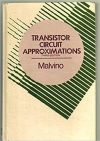
The third book, is hands down, the best book I've ever read when it comes to understanding how transistors work. When I was studying electronics, 30+ years ago, the teacher made us buy a university level, highly theoretical textbook for the course. One day, a couple of friends from class and myself, dropped by the teachers office to ask him a question. He wasn't in, but his office mate was. We struck up a conversation with him and when he asked how our electronics course was going, we told him we found the book very confusing and hard to understand. He reaches up into his colleagues bookshelf and pulls out the book by Malvino and says...'this is the book he actually uses'. I immediately ordered a copy and the clouds in my head dispersed and it all made sense! I couldn't believe how transistors were to understand.

Later, when I started teaching, I used to see the same confused look on my students faces when it came to understanding transistor circuit analysis and I would always say, 'it's just Ohm's Law and Kirchoff's Voltage Law'. Something I learned by reading Malvino. I used to say it so much, at the end of the semester they gave me a t-shirt that said...'it's just Ohm's Law and Kirchoff's Voltage Law'! lol

Transistor Circuit Approximations - Albert P. Malvino

1650634546235.png
 
Last edited:
Not trying to step on anyone's recommendations, but I feel like a guitarist should be able to get a great deal out of his gear without having to read up on the tech behind said gear.
I realize Fractal devices are quite complex, but I still think I needn't know the inner workings of a tube, for example, to be able to understand how an EL34-based power amp will sound, vs. a 6L6 one. Sure it still takes a certain amount of knowledge, but to use a racing analogy, I don't need to understand all the inner-workings of a transmission, to know I need a different gear ratio in turn 4, because neither 3rd nor 4th gear is keeping the engine in the best part of the powerband, for a fast exit out of that turn.
And it doesn't take a full understanding of sound waves to know how to boost certain frequencies in order to cut through a mix, as a basic example.
Basic understanding of frequencies of the various instruments, sure.
 
Isn’t that contrary to what you wrote in post #2?

“the "why" behind doing such things, with audio clips so the listener can truly hear what's happening. All these deep parameters, especially.”

How can a parameter such as Power Tube Bias Excursion be explained without telling what is represents? Without falling back to meaningless / subjective descriptions as “better”, “looser”, etc.
 
Isn’t that contrary to what you wrote in post #2?

“the "why" behind doing such things, with audio clips so the listener can truly hear what's happening. All these deep parameters, especially.”

How can a parameter such as Power Tube Bias Excursion be explained without telling what is represents? Without falling back to meaningless / subjective descriptions as “better”, “looser”, etc.
The "why" you would do something with a parameter, in the context of what it does to your sound, not the "why" it works from a technical standpoint. As an example, what has been asked in this thread: https://forum.fractalaudio.com/threads/to-fatten-or-add-girth-to-your-preset.183427/#post-2255483
I gotta say, it feels like you're trying to pick a fight. I'm just trying to voice my opinions in support of the OP.
 
I think it is a good idea, but I would guess it would take a bunch of resources from a small company. A "cert" idea is the way to go because even pro players don't want to spend all of their time knowing what is what. IT is like a protools certification....

AS things get more detailed and modeling advances it might become more common place in the future. And it would be a great selling point for the product - even though sales are good, they can always be better...
 
Back
Top Bottom