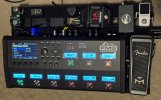
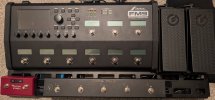
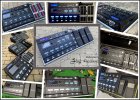
Here's my FM9 "rig"...
I use it instead of my AXE FX III rack system when stage space is limited or in case of transportation issues.
For even more strict trasportation needs (e.g. flights) I've built a third super compact & light system, but not based on Fractal.
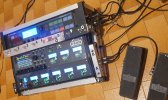
It's for both guitar an voice effects, in the top you see a TC HELICON "VOICELIVE RACK" (yes... a
rack device, floor mounted... 
) the same I have with in my AXE FX III rack system.
I've used 1" square aluminum tubes with plastic joints and it's SUPER SUPER strong. You can dance on it!
Probably I could have used a thinner one to reduce weight and size a little more.
The total weight is about
18 Kgs, not as low as I wanted...

Everything is calculated with half mm precision to reduce weight and size to the minimum.
For that reason I've used
1 single power supply with galvanic isolated outputs fo all the devices inside.
The FM9 isn't secured with screws and nothing of it has been modified, so I could replace it in 2 minutes.
The unit is held in place by the surrounding frame, which fits with absolute precision and touches only the rubber parts, plus two nylon zip ties.
Naturally, both the side and bottom vents are completely unobstructed."
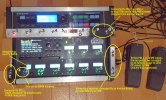
In the upper aluminum bar I've built a MIDI pedalboard to control the TC HELICON (buttons 1 to 8), with an
Arduino board to control also the LED display, manage 2 pedals (it also shows their position in the LED display), A and B switches and the MIDI IN (merged before going to FM9 MIDI).
Since for +20 years I have used
10x banks and
all my pedalboards too works by 10, maybe because Napoleon some time ago introduced this
weird decimal system...
FM9 seems sometimes to prefer the octal system...

so I tried to find a compromise using
program mapping, combining scenes from
two presets to get 10 scenes (typically 8+2). I arranged them to have 10 'sounds' per bank, which can be recalled with 10 buttons.
So in the upper side of the pedalboard I added two additional buttons "
9" and "
10" to do it, connected to PDL2 and PDL3 FM9 inputs.
Octal to decimal conversion done.
To
increase/decrease the bank I added a momentary "
-" button in the lower left side connected to PDL1 FM9 input.
I sacrificed the FM9 lower left button to perform the BANK increase "+".
All these 3 buttons are managed with FM9 Edit.
The display of lower left button is used to show the
current active BANK.
I added a
magnifying lens to have a better reading...
Unfortunately there's no way to see in very big fonts the "active bank" in the big colour display.
All the same unfortunately the "pointed bank" with + and - buttons is shown in the big FM9 display only in little fonts (nearly useless).
I've got no solution for it than posting wishes.
A and B momentary switches are connected to an internal Arduino board, programmed to send to the FM9 MIDI IN the CCs for be used as Modifiers.
Unfortunately Fractal didn't implemented a
momentary to toggle conversion option like many others do. Very easy to do, I posted a wish for it.
The
two Pedals are connected to the Arduino that sends CCs (0-127) to FM9 and used as modifiers (volume and expression), it also show their value in the LED display in the upper bar with special scheme on a single 7 segment LED I've invented...

It's was a hard work to program the Arduino to manage the pedals, but I was forced to do it to free the needed 3 buttons of FM9.
The Arduino also performs a
MIDI merge from the
MIDI IN in the panel of my system, in order to eventually connect bigger pedalboards I have (see images in the end of this post), wireless MIDI controls or simply a DAW control.
The entire system
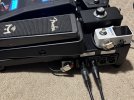
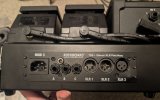
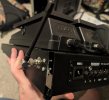
can be very easily opened for inspection/maintenance thanks to 4 latches, without the use of any tool (see side images).
In the side panel I have:
- additional MIDI IN to control everything with an external MIDI pedalboard / DAW / wireless MIDI
- Guitar IN that automatically switches wired / wireless
- stereo guitar OUTs for FOH (XLR)
- Mic IN (XLR)
- stereo mic OUTs for FOH (XLR)
- mono and stereo guitar IEM/Monitor OUT
- stereo voice IEM/Monitor OUT
- external AMP/Cabinet OUT Humbuster (from FM9 OUT3, bypassing CAB block)
- external SW A+B input (that double the ones I added later in the right side of FM9)
- PEDAL 1 and 2 inputs
- USB inputs (FM9 and TC-H)
- antenna inputs, but recently I disabled them since I added 2 panel antennas in the back panel (see rear images below) for LINE6 G55
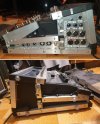
In the image above, you can also see the rubber feet that allow the system to be placed vertically, saving a lot of space when using an external MIDI foot controller.
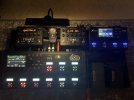
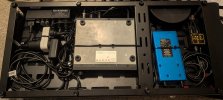
See below the system opened.
Inside there are additional devices: such as LINE6 wireless guitar system, single power supply (to save weight) with multiple galvanic isolated outputs, S/PDIF converter, a secret sauce pedal and - since mic signal is driven also to FM9 - I've designed a phantom power
super-protection to double protect an FM9 input, even if they are already Phantom tolerant
One day I will publish the schematic since I think it's much better than commercial ones (I used both DC blocking capacitors + limiting Zener diodes), and I carefully tested it before using it with FM9.
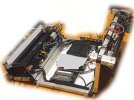
In the front/rear images below you can see the sturdy hinges that hold the aluminum frames together.
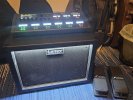
In the rear side I've put a couple of directive antennas, adjustable in order to reach the more difficult points in the venue (the panel in the back is in plastic material).

All my three rigs are programmed with a
uniform sounds numbering, organized in banks of 10 sounds each.
They can optionally be controlled by other pedalboards using an identical "sounds" (Fractal preset/scenes) order, with appropriate presets and program mapping.
So, if there is the space, I can connect to this FM9 system the same pedalboards I use for my AXE FX rack system. See below.
The reason for doing this is to have a faster pedalboard (I'm not a fan of round buttons),
and another great reason is to
keep the FM9 in a safe spot rather than right in front of me when playing at
dangerous venues...


you know what I mean
:
This is my
preferred one (big):
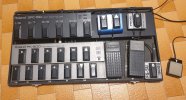
This is my
compact one, based on the cheap Behringer FCB1010
heavily modified by myself inside (I've published a tutorial in Youtube: e.g. all buttons replaced...) to increase its reliability:
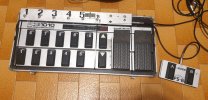
You see that both pedalboards work with 10 preset (Fractal scenes) per bank.
In all my systems in the same 5 pins MIDI connector I send also the 9V DC to power the pedalboards, so only 1 connection cable is required.
If you have any questions, feel free to ask!